Business

USA Economy, Fed & Inflation Update Today Insights
Business, Informative

USA Economy, Fed & Inflation Update Today Insights

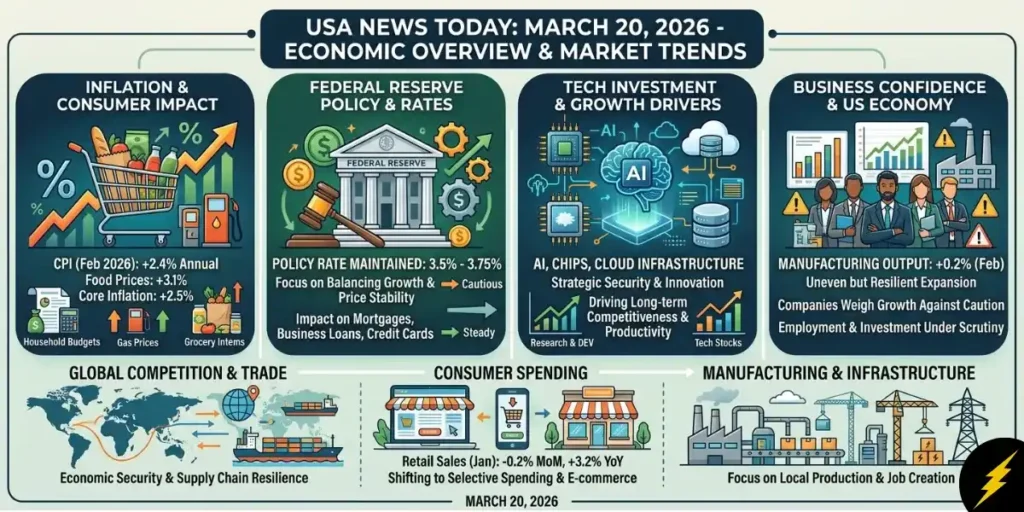
Overview It is another significant news cycle in the United States on March 20, 2026, and it is about to be the most attention-seeking news cycle since most of the news is about inflation, Federal Reserve policy, consumer demand, manufacturing, technology investment, and global competition. It is not that only one headline is the real story. The connection of these developments between markets, policy, business confidence and everyday life is the manner in which these changes are linked. Recent official figures indicated that consumer inflation in February remained at 2.4 in comparison with the previous year, and Federal Reserve in this week maintained its policy rate at 3.5 to 3.75. Cost of borrowing is one of the considerations in the country. Investors are looking to the Fed to see any indication of future rate reductions, businesses are weighing growth against caution, and households are still having to maneuver their spending choices by price, credit prices and work prospects. Technology is already among the largest growth stories, particularly in the areas of AI, chips, cloud infrastructure, and digital infrastructure, and Washington is still prioritizing competitiveness, manufacturing, strategic security, and the trade policy. Why does this matter? These trends do not just impact Wall Street alone. These affect the cost of mortgages, the cost of credit cards, employment, venture capital, consumer confidence, investment sentiment in the stock, and long-term business planning. This requires a whole picture and not disjointed pieces to readers seeking the news of the USA today as inflation, rates, industry and trade are all forming the American mindset in concert. Table of Contents 1. Inflation is one of the most important subjects. Inflation remains to be one of the most critical themes in the United States in a sense that it influences household budgets, business planning and the policy directions at the same time. The most recent official inflation rates that were issued on March 11, 2026 indicated that the all-items Consumer Price Index increased 2.4% in 12 months ending in February, and that core inflation, excluding food and energy, increased 2.5%. The food prices were also quite solid, and the increase was 3.1 percent per year. Although the rate of inflation is significantly lower than it was previously, inflation does have an impact in everyday life. Groceries, utilities, transport, and housing-related costs are some of the expenses that families still pay a lot of attention to. The pressure does not have to be as dramatic as in the past but it influences the purchase decisions, saving pattern, and trust. In the case of businesses, inflation has been observed to impact on the wages, cost of supply, prices strategy and planning. The inflation is always at the center of attention since financial markets can use it as a reference point to see what the Federal Reserve would do next. Any change in pressure of prices can affect the yield of bonds, stock forecasts, lending and even employment habits. This is the reason why inflation is one of the most powerful issues in USA news today. Key Points 2. Fed Policy Driven market Mood. The policy of Federal Reserve is one of the strongest levers on the U.S. economy and financial market. The range of the federal funds target maintained at 3.5% to 3.75 percentage by the Fed on March 18, 2026, indicates that the Fed is yet to make the decision that will change inflation, labor market, and the state of the entire economy and is still evaluating it closely. This move is important since the rates of interest influence the cost of borrowing in the economy. Home loans, business loans, automobiles and credit card loans are all subject to the Fed policy. When the rates remain at high levels, it makes financing costly and the economy may slow down. Investor sentiment can be enhanced when the markets get the impression that rates can be reduced later, but policy makers have to support growth and control inflation. Therefore, traders, analysts, business executives, and households scrutinize every Fed statement and meeting. Wall Street is not the only person to be affected by the Fed. Its choices make their way to the Main Street via the costs of mortgages, expansion of the businesses, servicing of debts, and consumer credit. This is why the current Fed policy is among the most potent market mood drivers. Key Points 3. Caution is the Strength of the US Economy. The U.S. economy remains robust, and things are not that easy. Certain signs point to further strength, and some are of concern and asymmetrical momentum. The industrial production or manufacturing output was up 0.2% in February 2026 following a 0.7% rise in January, and manufacturing output also improved by 0.2%. That is an indication that production activity is continuing even though growth may not be running at full blast. This is important since it is no longer possible to think about the economy with only a single number. At the same time it is possible to have a movement in different directions in employment conditions, inflation, retail demand, manufacturing activity, and business investment. Big companies can keep growing and less sensitive to the financing cost and changes in consumer demand, less sensitive will be small businesses. This is why no one can speak about pure strength or weakness of the present story. It concerns a phase of mix yet critical phase in terms of resilience and uncertainty co-existing. Context rather than noise is required of the readers since the economy is still expanding in certain sections, but the rate and assurance that the growth is taking place is being keenly monitored. Key Points 4. Tech Investment Remains a key Growth driver. The technological aspect of the United States continues to be one of the largest growth stories. AI, cloud service, semiconductor, cybersecurity and digital systems investment remains at the forefront of corporate strategy, market expectations and long-term competitiveness. It is no longer merely innovation that should be told about technology. It is productivity, capital spending,

USA News today: Economy, Fed, Tech and Trade In the Limelight.
Business

USA News today: Economy, Fed, Tech and Trade In the Limelight.

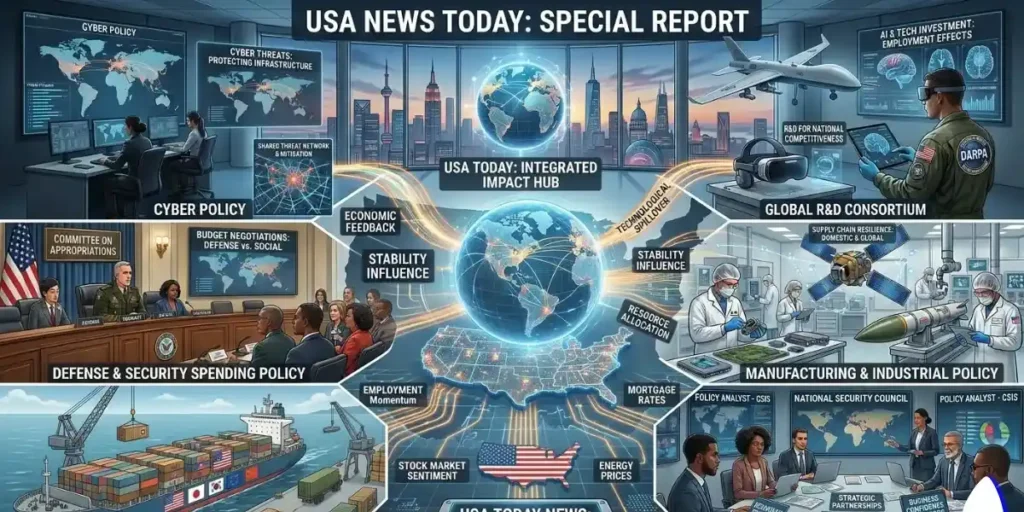
Overview The USA news is going through a historic news cycle. The major themes cover inflation, Fed expectations, tech growth, the priorities of the defense, consumer expenditures, and trade negotiations. The actual story to the readers is not a single headline, it is the connection between the economy, interest rates, big business choices, indication of the policy and popular confidence. Costs of borrowing are observed throughout business in the country. Shareholders pursue policy anticipations. Households observe employment, prices and the course of the market. Tech continues to influence growth narratives, whereas Washington is concerned with competition, manufacturing, security and international trade. Why care? Any significant economic change influences the everyday life. These big trends are connected to mortgage rates, employment, startup capital, stock feeling, Artificial Intelligence invested money, customer desires, and energy prices. It is necessary that the news readers should look at the whole rather than single updates. Table of Contents 1. Inflation continues to be among the hottest topics. The issue of inflation is still influencing the conversation in the country since it impacts the budgets of the households, their business planning as well as the message of the governments simultaneously. The increase in prices, even in response to earlier high-price increases, still puts pressure on the people as they have to pay on food, transportation, housing, and utility expenses. That is why the issue of inflation is still one of the most influential discussions in USA news. Purchasing behavior is altered as a result of inflation to families. Consumers are more price-sensitive, slow to make bigger purchases and seek out discounts more frequently. In the case of businesses, it increases the operations cost, both in terms of wages and logistics and inventory. To policy makers, it now becomes a test of means of checking whether the existing strategies are working at all. The issue of inflation is also relevant as it has a direct influence on financial markets. Investors consider the movement of the inflation in order to predict what the Federal Reserve will do next. Even the slightest change in the inflation will affect the bond yields, stock prices, lender confidence, and even in the hiring intentions. Key Points 2. Mood is still being driven by Federal Reserve Policy. The Federal Reserve defines economic expectations as few institutions. Each signal with regard to the interest rates is given a huge weight since the cost of borrowing funds is going to influence the businesses, banks, home buyers and the investors. This is why the Fed policy can be defined as one of the most influential drivers of the financial headlines today. As the rates continue to be high, the loans are pricier and growth may become chillier. The markets tend to respond positively when the reduction of the rates is evident. But the challenge is balance. Go at a faster rate and inflation may be reconsidered. Proceed at too slow a pace and growth can become even weaker. That is why any words of the speech, meeting and policy insinuation of the Fed catches the eye right away. All analysts, traders, and business leaders attempt to read between the lines. I is felt in real life by ordinary Americans in the shape of the credit card rates, the cost of home financing, development of businesses, and the momentum in the job market. Key Points 3. The US economy is also demonstrating better performance but with a few reservations. It is said that the American economy is resilient, which does not imply the existence of the risk gone. Increase in employment, services and investment may appear promising, but there are issues with regard to debt, affordability and lower rate of momentum in certain sectors. This ambivalent image lies in the core of USA news to-day. The significance of this story is that the economic strength is not necessarily considered by a single number anymore. There can be a strong employment and weak consumer confidence. Good corporate profits can occur when smaller enterprises have difficulties in financing. This makes the situation more complex than mere headlines make it appear. The same question that is being posed by people in the country is whether the economy is stable, slowing down or is it going to have a greater rebound? The solution seems to be in between. Current reporting is particularly important because the readers must have context and not noise. Key Points 4. One of the primary growth engines is technology Investment. A major influence on business confidence in the U.S. is still technology. The market discourse and corporate positioning remains a product of expenditure on AI, cloud, chips, cyber-security, and digital infrastructure. The technological industry is more than just a headline. It dictates the trends in hiring, it moves the stock market, influences the productivity objectives, and forms the future of the global competition. When big firms implement new tools or increase their sizes, the spread is befriended much beyond the industry. AI has added a new dimension. It is considered to be an opportunity by investors over the long run in terms of growth, and by governments as strategic priority. Businesses seek to adopt it as fast as possible, and employees want to know the effects it will have on professions and industries. Key Points 5. Consumer Spending continues to be of Tremendous importance. One of the most evident indicators of the U.S. economic situation is the consumer spending. As long as individuals continue to spend, companies remain active, employees retain their jobs and the economy gains confidence. The sudden slump in spending strains the economy on the whole. This is the reason why so much attention is paid to retail trends, travel demand, online shopping, and services. Household behavior displays comfort or stress in the finances and indicates whether inflation and high borrowing rates are permanently altering the habits. Nowadays, a great number of consumers continue to purchase, more carefully. They continue to buy necessities and pick experiences, but would be judicious in luxuries, electronics, non-urgent

USA News Today: Latest Fed, Tech and Economy News
Business, Breaking News

USA News Today: Latest Fed, Tech and Economy News

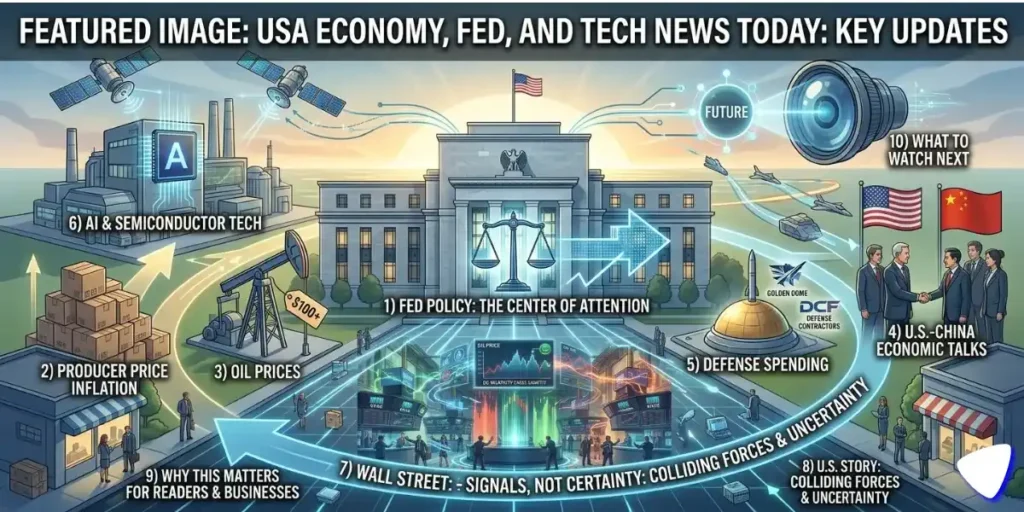
USA News Today: Why the Economy, Fed and Tech Story Matters More Than Ever The United States is moving through a day that feels bigger than a normal news cycle. This is not just about one political headline or one market reaction. The real story is how several forces are colliding at once: inflation pressure, Federal Reserve caution, oil market tension, renewed U.S.-China economic talks, rising defense commitments, and fresh momentum in artificial intelligence. Reuters reported on March 18, 2026 that markets were watching the Fed closely as oil stayed elevated and policy uncertainty remained high. Reuters also reported hotter U.S. producer price data, while U.S.-China economic officials continued talks tied to trade stability and a possible Trump-Xi summit later this month. At the same time, defense spending plans and AI-chip developments added even more weight to the day’s U.S. news picture. Instead of repeating a generic “top updates” format, this article looks at the deeper angle: why today’s U.S. headlines connect to each other, and what they may mean for ordinary readers, businesses, and investors. 1) The Federal Reserve is at the center of attention The biggest U.S. story today is the Federal Reserve’s balancing act. Reuters reported that the Fed was widely expected to hold rates steady, but the real question was whether policymakers would signal greater concern about inflation risks linked to the oil shock and broader geopolitical stress. That matters because even when rates do not move, the Fed’s tone can shape borrowing costs, business sentiment, and stock market direction. For readers, this is important because the Fed is still trying to protect growth without allowing inflation to regain strength. Mortgage decisions, credit costs, startup funding, and consumer confidence can all be affected by how cautious the central bank sounds. 2) Producer price data has added fresh inflation pressure Another key reason today feels important is inflation at the producer level. Reuters reported that U.S. producer prices rose more than expected in February, with services contributing to the increase and the Middle East conflict adding extra pressure through energy costs. This is a strong story angle for your blog because it moves beyond “numbers went up” and explains the chain effect. When producers pay more, businesses often try to pass on higher costs. That can affect transport, food, manufacturing, retail pricing, and eventually household budgets. So this is not just a technical business headline—it can become a daily life story for U.S. consumers. 3) Oil prices are shaping the U.S. economic mood Reuters said oil prices stayed above $100 a barrel amid conflict-related tension around regional supply routes, even though some pressure eased. That matters in the U.S. because energy prices do not stay in one lane. They influence shipping, airline costs, industrial production, and inflation expectations. A lot of people think oil news belongs only in the business section, but in reality it touches travel costs, delivery expenses, and market confidence. This is exactly the kind of angle that helps a news blog feel more original and useful. 4) U.S.-China economic talks are back in focus Reuters reported that senior U.S. and Chinese economic officials met in Paris to keep trade discussions alive and prepare the path for a possible summit between President Donald Trump and President Xi Jinping later in March 2026. The talks reportedly covered tariffs, technology export controls, rare earth supply, and agricultural trade. This gives your article a stronger ranking angle because it connects U.S. domestic business concerns with global diplomacy. American tech and manufacturing firms care about rare earth access, export rules, and tariff stability. Farmers care about Chinese purchases. Investors care about whether the relationship remains stable or gets worse. One meeting can affect multiple sectors at once. 5) Defense spending is rising again in a big way Reuters’ U.S. news coverage reported that the estimated cost of the “Golden Dome” missile defense shield increased to $185 billion, with Lockheed Martin, RTX, and Northrop Grumman involved as prime contractors. This is not only a defense story. It is also an economic and industrial story. Big national security programs can shape public spending priorities, defense jobs, manufacturing demand, and political debate. A unique blog does better when it shows readers that one headline has multiple layers, instead of treating it like a single isolated update. 6) AI and semiconductors remain a major American story Reuters’ March 18 technology coverage highlighted strong attention around AI, chip demand, and major semiconductor partnerships, while separate reporting noted Nvidia-related developments and broader excitement in the AI space. For a USA news blog, this is useful because AI is no longer just a Silicon Valley story. It is now linked to jobs, data centers, chip supply chains, international competition, and market valuation. Articles that explain why AI matters to the wider economy tend to feel fresher than posts that simply repeat “AI is booming.” 7) Wall Street is reacting to signals, not certainty Reuters reported that U.S. stocks had responded positively when oil volatility eased slightly, but investors remained cautious because the bigger risks were not gone. That is the perfect place to add human-style explanation: markets often move not because problems disappear, but because fears become temporarily less intense. This makes your content sound more natural and analytical. It avoids robotic template writing and gives the article a real editorial voice. 8) The real U.S. story is uncertainty across many sectors What makes today’s USA news different is not one giant event. It is the combination of policy caution, inflation pressure, geopolitical risk, technology competition, and defense expansion all happening together. Reuters coverage across business, markets, and U.S. news reflects this overlap clearly on March 18, 2026. This is the strongest unique angle for your article: America is not reacting to one problem today; it is adjusting to several pressures at the same time. That makes the country’s economic mood more fragile, but it also explains why every Fed signal, trade meeting, and market move is getting so much attention. 9) Why this

CLC NEW'S


Subscribe For More Updates

This will close in 20 seconds

Scroll to Top