Informative

Trump Iran Naval Blockade & Rory McIlroy Masters
Breaking News, Business, Informative

Trump Iran Naval Blockade & Rory McIlroy Masters

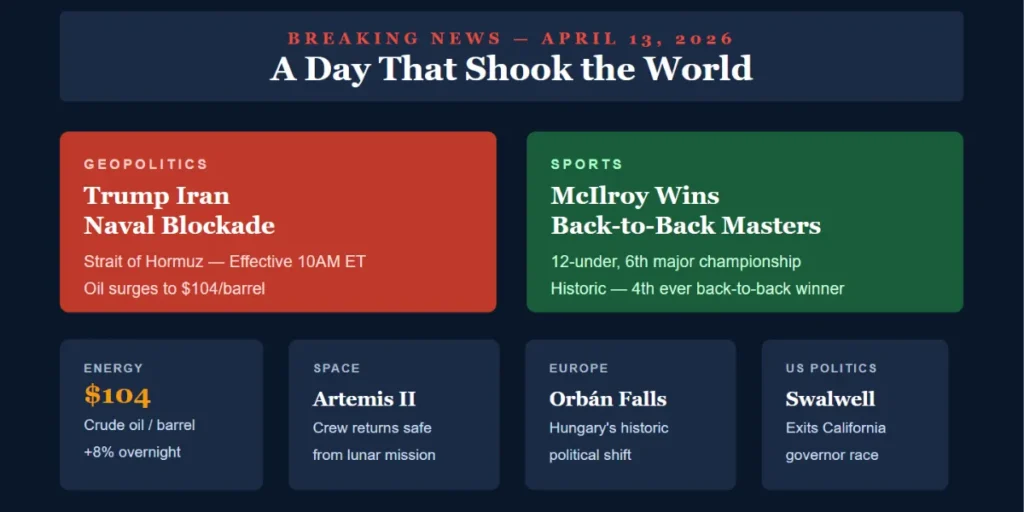
Trump Iran Naval Blockade & Rory McIlroy Masters Monday, April 13, 2026 arrives with a wave of seismic developments spanning geopolitics, sports, energy, and American domestic politics. At the heart of it all is the Trump Iran naval blockade — announced hours after peace negotiations collapsed in Islamabad — which has immediately sent shockwaves through global energy markets, pushed crude oil above $104 per barrel, and put US military forces on a heightened combat footing in the Persian Gulf. Meanwhile, golf fans worldwide witnessed one of Augusta National’s most dramatic final rounds as Rory McIlroy defended his Masters title in a one-shot thriller to claim his sixth major championship. The bigger picture These stories matter because they carry direct consequences for everyday Americans and global citizens alike. The Strait of Hormuz crisis affects fuel costs, inflation, and the risk of wider military conflict. Rising oil prices today threaten to reverse economic gains, strain household budgets, and ripple into airline fares, food prices, and manufacturing costs. On the brighter side, sports milestones like McIlroy’s back-to-back Masters triumph remind the world that individual excellence still cuts through the noise — even during times of geopolitical turbulence. Trump Iran naval blockade: What happened and what comes next The most urgent story dominating Monday’s news cycle is the Trump Iran naval blockade of the Strait of Hormuz, declared by President Donald Trump on Sunday following the total collapse of marathon peace talks held in Islamabad, Pakistan. Vice President JD Vance led the US delegation through more than 21 straight hours of negotiations, ultimately walking away after Tehran refused to commit to dismantling its nuclear enrichment program — the single deal-breaker Washington insisted upon. Trump announced the blockade would prevent any vessel from entering or leaving the Strait, and that the US Navy would also hunt down ships that had paid Iran a toll for passage — aiming to cut Tehran’s oil revenues entirely. US Central Command formally announced the blockade would take effect at 10 a.m. ET on Monday. Oil prices crossed $100 a barrel again almost immediately, with Brent crude surging 8%, as analysts warned that elevated energy costs could persist well into late 2026. Key point 21+ hours of failed talks in Islamabad US Navy blockade effective April 13 Iran refused nuclear deal commitments Allies exploring coalition response Rory McIlroy makes Masters history with back-to-back green jackets In one of Augusta National’s most gripping Sunday finales in years, Rory McIlroy Masters 2026 became the defining sports headline of the weekend. McIlroy — who had entered the weekend with a tournament-record six-shot lead before losing it in the third round — overcame a rocky start in the final round to finish 12-under and win by one shot over Scottie Scheffler. The Northern Irishman is now only the fourth golfer in history to win back-to-back Masters titles, joining Jack Nicklaus, Nick Faldo, and Tiger Woods in that elite company. His sixth major championship ties him with Faldo for the most ever by a European player in the modern era — a remarkable achievement for a player who waited 17 years between his first and second green jackets. Key points Won 12-under, one shot clear 6th major championship overall 4th back-to-back Masters winner ever Scheffler runner-up at 11-under Oil prices today: Crude smashes $104 as Hormuz blockade hits markets Global financial markets opened Monday under heavy pressure. Crude oil surged to $104.23 per barrel — up nearly 8% — as the Hormuz blockade announcement triggered immediate supply-disruption fears, with Brent crude also crossing $101 in early Asian trade. S&P 500 index futures fell 0.7% as higher oil prices threatened broader economic growth, while Asian shares dropped nearly 1%. The oil prices today spike extends a trend that has seen crude rise over 69% compared to the same period last year, fueled almost entirely by the US-Iran conflict and the ongoing closure of the Strait of Hormuz since late February. Eric Swalwell exits California governor race On the domestic front, Representative Eric Swalwell dropped his bid for the California governor’s office after mounting pressure from within his own party following a damaging public report. The exit reshapes an already crowded Democratic field in one of the country’s most politically significant states. The development comes as Democrats seek to consolidate their presence in California ahead of the 2026 midterm cycle. Key point Swalwell exits governor race Democrats push for consolidation California race now wide open Major political implications ahead Artemis II crew returns from lunar mission The four-person Artemis II crew spoke publicly for the first time since returning to Earth on Friday following 10 days in deep space, describing the experience as profoundly emotional and saying they felt permanently bonded by the mission. The safe return marks a significant milestone for NASA’s lunar exploration program and restores public confidence in crewed spaceflight after a period dominated by military and economic headlines. Hungary’s Orbán concedes historic election defeat In a stunning political development, Hungarian Prime Minister Viktor Orbán conceded defeat on Sunday as opposition leader Péter Magyar surged toward a potential supermajority win — marking the most dramatic political shift Hungary has seen in over a decade. The result signals a major realignment for Central European politics and has broad implications for EU cohesion and Hungary’s relationship with both Washington and Brussels. Stock market impact: S&P futures, Asian markets under pressure The combined weight of the Strait of Hormuz crisis and the breakdown of the Iran nuclear talks is bearing down on investor confidence globally. Markets that had rallied sharply on ceasefire optimism just days ago are now facing renewed headwinds. Energy stocks are climbing while transportation, airlines, and consumer discretionary sectors are absorbing losses. Economists warn that if the blockade holds beyond two weeks, inflation figures for May and June will reflect a significant energy price shock, complicating the Federal Reserve’s rate-setting agenda for the remainder of 2026. Impact across sectors, citizens, and global stability Today’s headlines are not isolated events — they are connected threads in a rapidly shifting global story. The Trump Iran naval blockade does not just affect oil traders;

Global Sports & Market Pulse: Live Updates Today
Breaking News, Business, Informative

Global Sports & Market Pulse: Live Updates Today

On April 11, 2026, global headlines are driven by a mix of high-stakes football, retail behavior shifts, and international defense monitoring. From ongoing domestic cup action to major European clashes like Manchester City vs Liverpool FC, the global sports pulse live remains intense. Meanwhile, retail trends and rising talents like Sameer Rizvi are shaping search behavior across regions. Why This Matters Today’s updates reflect how audiences are balancing entertainment, shopping planning, and global awareness. The rise of retail holiday tracker 2026 and defense airwatch update searches shows users are actively tracking both lifestyle and geopolitical developments. 1. Domestic Cup Fixtures Today Football fans are actively tracking knockout fixtures as domestic competitions heat up. Key Points 2. Retail Holiday Tracker 2026 Consumers are closely monitoring store availability during seasonal holidays. Key Points 3. Tactical Insight: Guardiola Approach Pep Guardiola continues to influence the football tactical update today conversation. Key Points 4. Defense Airwatch Update Global attention is shifting toward aerial defense monitoring. Key Points 5. Emerging Cricket Radar India Sameer Rizvi is trending under the emerging cricket radar India category. Key Points 6. SC Freiburg vs Bayern Munich Bayern Munich faces SC Freiburg in a crucial Bundesliga fixture. Key Points 7. Real Sociedad vs Levante Real Sociedad meets Levante UD in a competitive league clash. Key Points 8. Mallorca vs Real Madrid Real Madrid takes on RCD Mallorca in a key fixture. Key Points 9. Man City vs Liverpool Spotlight The clash between Manchester City and Liverpool FC dominates the global sports pulse live. Key Points 10. CIMA Career Outlook Chartered Institute of Management Accountants remains a strong career pathway. Key Points FAQs Q1. What is global sports pulse live?It refers to real-time updates across major sports events happening worldwide. Q2. What does retail holiday tracker 2026 mean?It tracks store openings, closures, and shopping trends during holidays. Q3. Which match is trending today?Manchester City vs Liverpool is leading global search trends. Q4. Who is Sameer Rizvi?A rising Indian cricketer gaining attention for consistent performances. Q5. What is defense airwatch update?It covers global aerial defense monitoring and strategic developments. Conclusion Today’s developments showcase a dynamic mix of sports excitement, retail behavior, and global awareness. From the global sports pulse live to emerging trends like emerging cricket radar India, audiences are consuming real-time, multi-sector updates more than ever. Stay ahead with real-time updates—follow now for the fastest global news insights. 👉CLICK HERE 🔗

Air Force Pilot Rescued Iran: News & Updates 2026
Breaking News, Business, Informative

Air Force Pilot Rescued Iran: News & Updates 2026

On April 5, 2026, global headlines are dominated by defense developments, economic policy shifts, and sports action. From the Air Force pilot rescued Iran update to retail searches like Dollar General Easter hours, users are actively tracking real-time developments across multiple sectors. Trending topics also include airport activity, federal legal tensions, and major football clashes like Angers vs Lyon. 1. Air Force Pilot Rescued Iran Recent reports confirm that an air force pilot rescued Iran operation has gained international attention due to its strategic sensitivity. Key Highlights: This story is becoming one of the most searched global defense updates today. 2. Fort Lauderdale-Hollywood International Airport Updates Activity at Fort Lauderdale-Hollywood International Airport is trending due to operational and travel-related updates. Key Highlights: Travelers are advised to check schedules before departure. 3. Federal Reserve Subpoenas Rejected The Federal Reserve is in focus after reports that certain subpoenas were rejected. Key Highlights: This development could impact future financial regulations. 4. ICE Policy and Enforcement Updates U.S. Immigration and Customs Enforcement continues to trend due to enforcement-related updates. Key Highlights: 5. Justice Samuel Alito Hospitalized Samuel Alito has reportedly been hospitalized, raising concerns across legal and political circles. Key Highlights: 6. Nancy Guthrie in News Nancy Guthrie is trending due to recent public appearances and discussions. Key Highlights: 7. Adam Schefter Updates Sports analyst Adam Schefter is trending with breaking NFL-related updates. Key Highlights: 8. Angers vs Lyon Match The Ligue 1 clash between Angers SCO and Olympique Lyonnais is drawing attention. Key Highlights: 9. Neil McCasland Spotlight Neil McCasland is gaining recognition in sports discussions. Key Highlights: 10. Dollar General Easter Hours 2026 Retail searches are high for Dollar General regarding Easter hours. Key Highlights: FAQs Q1. What is the Air Force pilot rescued Iran update?A rescue mission involving a pilot has gained global attention due to geopolitical sensitivity. Q2. Is Dollar General open on Easter 2026?Most locations are open but may operate with reduced hours. Q3. Why is Fort Lauderdale Airport trending?Due to increased travel activity and operational updates. Q4. Who is Adam Schefter?A well-known NFL insider providing breaking sports news. Q5. What is Angers vs Lyon match significance?It’s an important Ligue 1 fixture impacting league standings. Conclusion April 5, 2026, brings a diverse mix of headlines—from defense updates like Force pilot rescued Iran to retail searches like Dollar General Easter hours and sports action worldwide. These trends reflect real-time user interest and evolving global focus, making today’s news cycle both dynamic and highly engaging. STAY UPDATED WITH US 👉CLICK HERE

USA Updates Today: War & Economy Breaking Alerts Now
Breaking News, Business, Informative

USA Updates Today: War & Economy Breaking Alerts Now

USA Updates Today: War & Economy Breaking Alerts Now The United States is currently facing an intense and fast-changing news cycle. The biggest highlights include rising global tensions, especially around Iran, alongside economic pressure, Federal Reserve signals, and technology growth. This is not just a single headline story — it is a powerful combination of usa updates, war updates, and financial movements shaping global stability. Readers today are focusing on how geopolitical risks and economic decisions are deeply connected. From iran usa war updates to inflation and policy shifts, every development is influencing markets, businesses, and everyday life. 1. Rising Iran-USA Tensions The biggest headline in war updates is the increasing tension between the US and Iran. Military positioning, warnings, and diplomatic signals are raising global concern. This iran usa war updates situation is not just political — it has global economic consequences. Markets react instantly to any escalation signals. Key Points 2. Federal Reserve and Market Reactions The Federal Reserve remains a central force in shaping economic expectations. Interest rate signals are closely watched as uncertainty grows due to geopolitical risks. Investors are balancing war updates with policy expectations, making markets highly sensitive. Key Points 3. US Economy Under Pressure The economy is stable but facing pressure from inflation and global conflict risks. The usa right now news shows mixed signals — strong employment but cautious spending and investment. Key Points 4. Technology Sector Stability Technology continues to support growth despite uncertainty. AI, cybersecurity, and digital investments remain strong. Even during iran vs usa update concerns, tech remains a long-term growth driver. Key Points 5. Consumer Spending Behavior Consumers are still spending but more carefully. Rising costs and uncertainty are changing buying habits. This reflects how usa updates impact daily life directly. Key Points 6. Global Trade Impact Trade is highly sensitive to geopolitical tensions. The iran usa war updates are influencing supply chains, shipping routes, and global trade decisions. Key Points 7. Defense and Military Focus Defense spending is increasing as tensions rise. The iran vs usa update is pushing stronger military preparedness and policy focus. Key Points 8. Energy Prices and Supply Risks Energy markets are highly reactive to war risks. Oil prices often surge with Middle East tensions. This is one of the biggest impacts of current war updates. Key Points 9. Business Confidence Challenges Businesses are operating cautiously due to uncertainty. The combination of economic pressure and usa updates is affecting investment decisions. Key Points 10. Why This USA News Matters This news cycle is important because it affects everyone — from fuel prices to job markets and global stability. The mix of usa right now news, war updates, and economic changes makes this a high-impact story. Key Points Frequently Asked Questions Q1. What is the biggest USA news today? The biggest story is rising Iran-USA tension along with economic uncertainty and policy changes. Q2. Why are Iran-USA tensions important? They affect global markets, oil prices, and international security. Q3. How does this impact the economy? It creates uncertainty, affecting trade, investment, and consumer confidence. Q4. Are markets reacting to war updates? Yes, markets are highly sensitive to geopolitical risks and policy signals. Q5. What should readers focus on? Focus on the connection between war updates, economy, and policy decisions. Conclusion Today’s usa updates reflect a powerful mix of geopolitical tension and economic movement. The rising Iran-USA war, Federal Reserve signals, and global uncertainty are shaping the future direction of markets and policies. Want real-time USA updates and global war updates? Join us now and stay one step ahead of the world. Read More About: breaking-war-updates

USA Economy, Fed & Inflation Update Today Insights
Business, Informative

USA Economy, Fed & Inflation Update Today Insights

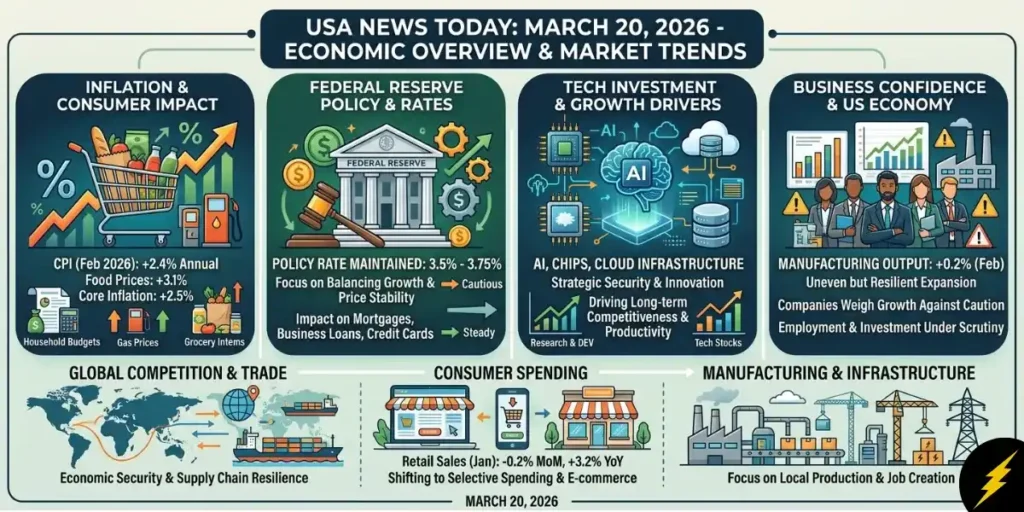
Overview It is another significant news cycle in the United States on March 20, 2026, and it is about to be the most attention-seeking news cycle since most of the news is about inflation, Federal Reserve policy, consumer demand, manufacturing, technology investment, and global competition. It is not that only one headline is the real story. The connection of these developments between markets, policy, business confidence and everyday life is the manner in which these changes are linked. Recent official figures indicated that consumer inflation in February remained at 2.4 in comparison with the previous year, and Federal Reserve in this week maintained its policy rate at 3.5 to 3.75. Cost of borrowing is one of the considerations in the country. Investors are looking to the Fed to see any indication of future rate reductions, businesses are weighing growth against caution, and households are still having to maneuver their spending choices by price, credit prices and work prospects. Technology is already among the largest growth stories, particularly in the areas of AI, chips, cloud infrastructure, and digital infrastructure, and Washington is still prioritizing competitiveness, manufacturing, strategic security, and the trade policy. Why does this matter? These trends do not just impact Wall Street alone. These affect the cost of mortgages, the cost of credit cards, employment, venture capital, consumer confidence, investment sentiment in the stock, and long-term business planning. This requires a whole picture and not disjointed pieces to readers seeking the news of the USA today as inflation, rates, industry and trade are all forming the American mindset in concert. Table of Contents 1. Inflation is one of the most important subjects. Inflation remains to be one of the most critical themes in the United States in a sense that it influences household budgets, business planning and the policy directions at the same time. The most recent official inflation rates that were issued on March 11, 2026 indicated that the all-items Consumer Price Index increased 2.4% in 12 months ending in February, and that core inflation, excluding food and energy, increased 2.5%. The food prices were also quite solid, and the increase was 3.1 percent per year. Although the rate of inflation is significantly lower than it was previously, inflation does have an impact in everyday life. Groceries, utilities, transport, and housing-related costs are some of the expenses that families still pay a lot of attention to. The pressure does not have to be as dramatic as in the past but it influences the purchase decisions, saving pattern, and trust. In the case of businesses, inflation has been observed to impact on the wages, cost of supply, prices strategy and planning. The inflation is always at the center of attention since financial markets can use it as a reference point to see what the Federal Reserve would do next. Any change in pressure of prices can affect the yield of bonds, stock forecasts, lending and even employment habits. This is the reason why inflation is one of the most powerful issues in USA news today. Key Points 2. Fed Policy Driven market Mood. The policy of Federal Reserve is one of the strongest levers on the U.S. economy and financial market. The range of the federal funds target maintained at 3.5% to 3.75 percentage by the Fed on March 18, 2026, indicates that the Fed is yet to make the decision that will change inflation, labor market, and the state of the entire economy and is still evaluating it closely. This move is important since the rates of interest influence the cost of borrowing in the economy. Home loans, business loans, automobiles and credit card loans are all subject to the Fed policy. When the rates remain at high levels, it makes financing costly and the economy may slow down. Investor sentiment can be enhanced when the markets get the impression that rates can be reduced later, but policy makers have to support growth and control inflation. Therefore, traders, analysts, business executives, and households scrutinize every Fed statement and meeting. Wall Street is not the only person to be affected by the Fed. Its choices make their way to the Main Street via the costs of mortgages, expansion of the businesses, servicing of debts, and consumer credit. This is why the current Fed policy is among the most potent market mood drivers. Key Points 3. Caution is the Strength of the US Economy. The U.S. economy remains robust, and things are not that easy. Certain signs point to further strength, and some are of concern and asymmetrical momentum. The industrial production or manufacturing output was up 0.2% in February 2026 following a 0.7% rise in January, and manufacturing output also improved by 0.2%. That is an indication that production activity is continuing even though growth may not be running at full blast. This is important since it is no longer possible to think about the economy with only a single number. At the same time it is possible to have a movement in different directions in employment conditions, inflation, retail demand, manufacturing activity, and business investment. Big companies can keep growing and less sensitive to the financing cost and changes in consumer demand, less sensitive will be small businesses. This is why no one can speak about pure strength or weakness of the present story. It concerns a phase of mix yet critical phase in terms of resilience and uncertainty co-existing. Context rather than noise is required of the readers since the economy is still expanding in certain sections, but the rate and assurance that the growth is taking place is being keenly monitored. Key Points 4. Tech Investment Remains a key Growth driver. The technological aspect of the United States continues to be one of the largest growth stories. AI, cloud service, semiconductor, cybersecurity and digital systems investment remains at the forefront of corporate strategy, market expectations and long-term competitiveness. It is no longer merely innovation that should be told about technology. It is productivity, capital spending,

The National AI Grid, an advanced digital infrastructure uniting supercomputing centers, massive data repositories, and research laboratories across the nation in 2030?
Informative, Technology

The National AI Grid, an advanced digital infrastructure uniting supercomputing centers, massive data repositories, and research laboratories across the nation in 2030?

1. Establishment of the National AI Grid By 2030, India will complete the National AI Grid, an advanced digital infrastructure uniting supercomputing centers, massive data repositories, and research laboratories across the nation. This interconnected ecosystem will provide scalable, secure, and affordable AI resources to startups, industries, and researchers. The AI Grid will function like a digital power grid—delivering computational energy and data intelligence nationwide. It will empower innovators with access to high-performance computing (HPC) clusters capable of processing massive datasets and training complex models. This network will reduce India’s reliance on foreign cloud services and promote cost-effective, sovereign AI development. By standardizing data formats and resource-sharing protocols, the Grid will accelerate breakthroughs in various sectors—ranging from healthcare and agriculture to manufacturing and education. Ultimately, the National AI Grid will be the backbone of India’s AI revolution, ensuring inclusive access to world-class digital infrastructure for every region. 2. Integration of Quantum Computing and 6G Connectivity India’s AI ecosystem will be supercharged by quantum computing and 6G networks, forming the technological foundation for next-generation intelligence systems. Quantum processors will perform complex simulations, cryptographic operations, and optimization tasks far beyond classical computing capabilities. Meanwhile, 6G will provide ultra-fast, low-latency data transfer, enabling real-time AI applications in autonomous vehicles, telemedicine, and robotics. The synergy between quantum and 6G technologies will make distributed AI systems highly responsive and efficient, even in remote areas. This will also enable seamless collaboration between cloud and edge computing environments. By integrating these technologies into national infrastructure, India will achieve exponential growth in computing capacity, supporting AI innovations that rely on instantaneous data exchange and massive model training. Together, they will empower industries to perform real-time decision-making and predictive analytics, positioning India at the forefront of global AI-powered digital transformation. 3. Expansion of AI-Optimized Data Centers To sustain large-scale AI development, India will establish a network of AI-optimized data centers across key states—Telangana, Gujarat, Karnataka, and Tamil Nadu. These facilities will feature high-performance GPUs, liquid-cooling systems, and renewable energy integration to minimize environmental impact. Data centers will act as the operational heart of the National AI Grid, enabling large-scale data analysis, model training, and real-time analytics. Edge data centers will be deployed in Tier-2 and Tier-3 cities, ensuring low-latency access to AI infrastructure for local enterprises. This distributed model will foster regional innovation ecosystems and support localized AI research. By integrating sustainable practices such as solar-powered cooling and energy-efficient chips, these centers will balance performance with environmental responsibility. Collectively, India’s data center expansion will create a resilient digital foundation capable of supporting national-scale AI initiatives and international technology partnerships. 4. Digital India 2.0 – AI-Driven Governance Framework The Digital India 2.0 initiative will evolve into an AI-powered governance framework, embedding intelligent systems into the country’s public administration. AI-driven analytics will guide policy decisions, optimize welfare distribution, and streamline government services. Real-time dashboards will track social welfare programs, health metrics, and environmental indicators, allowing data-based governance at every level. Blockchain integration will enhance transparency, while AI-enabled chatbots will assist citizens in accessing government schemes efficiently. Predictive algorithms will detect fraud, improve infrastructure planning, and enhance service delivery. Moreover, interoperable databases will ensure seamless coordination between ministries, making governance faster and more efficient. This shift from a digital government to an “intelligent government” will represent a milestone in India’s administrative modernization, improving citizen engagement and accountability. The outcome will be a resilient digital economy that harnesses the full power of artificial intelligence to drive national development. 5. AI-Powered Education Ecosystem By 2030, India will implement a comprehensive AI-driven education ecosystem as part of NEP 2.0. This system will introduce coding, robotics, and data science at the school level to build AI literacy from an early age. Universities will collaborate with technology companies to create AI research labs, offering hands-on experience and certification programs in emerging technologies. Virtual AI tutors will deliver personalized learning experiences, adjusting content to individual learning speeds and styles. These platforms will support multilingual learning, ensuring inclusivity across India’s diverse linguistic landscape. Public-private partnerships will provide affordable access to AI-based training and upskilling programs, bridging the gap between academia and industry needs. By integrating AI into education policy, India will cultivate a highly skilled workforce ready to drive the nation’s digital transformation, making AI knowledge a universal asset accessible to all learners nationwide. 6. AI-Enabled Smart Cities and Urban Innovation India’s Smart Cities Mission will evolve into a network of AI-empowered urban ecosystems. Through IoT sensors, connected grids, and predictive algorithms, cities will manage energy, traffic, waste, and public safety more efficiently. AI-driven systems will predict infrastructure failures and enable timely maintenance, improving city sustainability. Urban planners will use AI to simulate development models, optimizing resource allocation and environmental impact. Intelligent surveillance and emergency response systems will enhance safety, while AI-powered energy management will promote cleaner and more sustainable city operations. These technologies will create smarter, safer, and more livable cities across India. Smaller municipalities will also adopt modular AI frameworks suited to their scale, ensuring that urban innovation reaches beyond metropolitan hubs. In doing so, India’s cities will become models of global smart governance, integrating technology with human-centered design and sustainable development principles. 7. Bharat-AI Cloud – India’s Sovereign AI Platform India will launch the Bharat-AI Cloud, a sovereign national platform designed to provide democratized access to AI resources. Supported by MeitY and NITI Aayog, this infrastructure will offer scalable computing power, public datasets, APIs, and pre-trained AI models. Its goal is to eliminate barriers for startups and researchers by offering affordable and secure computing resources. Built with privacy-first architecture, it will host anonymized datasets for AI experimentation while ensuring compliance with ethical standards. Integrated with the National Knowledge Network (NKN), the platform will allow universities and research centers to collaborate seamlessly. It will include tools for model validation, transparency audits, and performance monitoring, ensuring trust and reliability in AI applications. Bharat-AI Cloud will act as the foundation of India’s AI innovation ecosystem, fostering homegrown technologies and strengthening national digital sovereignty across industries. 8. National AI Governance

Informative, Technology

By 2030, corporations will rely on AI-driven decision frameworks that act as intelligent “executive layers.”

1. Autonomous Decision-Making Frameworks By 2030, corporations will rely on AI-driven decision frameworks that act as intelligent “executive layers.” These systems will independently assess massive datasets, simulate outcomes, and make real-time decisions in finance, logistics, HR, and cybersecurity. AI will eliminate bias, reduce latency, and provide strategic insights faster than any human team. Through continuous learning, these frameworks will evolve based on new data, ensuring decisions remain relevant and ethical. Supported by legal and environmental compliance engines, AI governance layers will ensure that automated actions adhere to regulatory standards. This will redefine leadership structures—human executives will oversee AI systems rather than making every decision manually. The result will be organizations that are faster, more objective, and strategically adaptable to market fluctuations, making corporate agility and precision the new business standard. 2. Fully Autonomous IT Infrastructure The IT backbone of 2030 will no longer depend on manual intervention. AI-powered systems will manage infrastructure with self-healing, self-configuring, and self-optimizing capabilities. Through integrated robotic process automation (RPA) and natural language processing (NLP), IT environments will automatically detect anomalies, deploy fixes, and allocate resources across servers or cloud networks. Predictive maintenance powered by machine learning will identify potential system failures before they occur, ensuring near-zero downtime. This will drastically lower operational costs and reduce human error. In effect, corporate IT departments will transform from reactive problem-solvers into proactive orchestrators of intelligent digital ecosystems. The autonomous infrastructure will enable uninterrupted business continuity while adapting dynamically to evolving workloads, security needs, and business demands. 3. Predictive AI-Driven Cybersecurity Cybersecurity in 2030 will be predictive rather than reactive. AI algorithms will continuously monitor digital ecosystems, detect anomalies, and neutralize emerging threats in real time. Using deep learning and behavioral analysis, these systems will anticipate hacker patterns and prevent breaches before they happen. They will learn from every cyberattack, improving autonomously after each incident. AI will protect data across IoT devices, cloud services, and global supply chains with dynamic, context-aware firewalls. Integration with quantum encryption will ensure unbreakable security. Furthermore, AI-powered governance will continuously verify compliance with global data protection regulations. This proactive defense approach will make cybersecurity an intelligent, self-evolving process that significantly minimizes human oversight and reduces the impact of cyber threats on critical operations. 4. AI Forecast Management and Strategic Planning By 2030, traditional forecasting methods will be replaced by AI-driven strategic planning systems. These platforms will aggregate real-time data from consumer trends, financial markets, and global events, generating scenario-based predictions that guide executive decision-making. AI will simulate the impact of strategic choices before they’re executed, minimizing risk. For instance, an AI could analyze global trade patterns, climate risks, and political conditions to recommend investment timing. Such predictive insight will turn uncertainty into a manageable variable. Executives will no longer rely solely on intuition but on AI-backed foresight, ensuring decisions are data-grounded and future-oriented. These systems will make organizations resilient to volatility and capable of anticipating disruptions long before they occur. 5. Human-AI Collaboration Ecosystems AI will not replace humans—it will enhance them. In 2030, corporate environments will integrate human-AI collaboration frameworks where digital twins simulate workflows, manufacturing processes, and even employee performance. These virtual models will allow managers to test process changes without real-world risks. Personal AI assistants will handle scheduling, document organization, and communication prioritization, allowing employees to focus on creativity and strategy. AI mentors will monitor employee performance and suggest personalized development plans. Collaboration platforms will integrate natural language AI capable of summarizing meetings, generating insights, and facilitating cross-department innovation. Together, this human-AI synergy will increase workplace efficiency and satisfaction while creating a workforce that continuously learns, adapts, and innovates. 6. Generative AI in Product Design and Innovation Generative AI will dominate corporate innovation by 2030. Using neural networks and simulation modeling, AI will autonomously design products, write software code, and even test market responses before production. In manufacturing, generative algorithms will optimize material usage, reduce waste, and enhance durability. In IT, AI will write and debug code, accelerating development cycles. Corporate R&D departments will evolve into AI-assisted creativity hubs, where ideas are generated, validated, and refined in real time. This approach will shorten time-to-market while lowering development costs. Organizations will transition from reactive innovation to predictive creation, where AI anticipates market demands and creates solutions ahead of competitors. 7. Autonomous Business Intelligence (AI BI 2.0) Business Intelligence will move beyond static dashboards to AI-driven “thinking” systems that interpret data, identify anomalies, and provide actionable insights autonomously. Executives will interact with BI platforms via natural language—asking questions and receiving AI-generated strategic recommendations. These systems will integrate financial performance, consumer sentiment, and operational analytics into unified reports. AI’s ability to contextualize data will ensure that leaders receive not just information, but decisions supported by statistical confidence levels. Over time, BI systems will learn organizational priorities, evolving into digital advisors capable of simulating outcomes and suggesting risk-adjusted strategies. This transformation will democratize data access and make real-time analytics a foundation of all corporate decision-making. 8. AI-Driven Supply Chain Intelligence Supply chain operations will become fully autonomous by 2030. AI systems will track global logistics using real-time satellite imagery, IoT sensors, and predictive modeling. They will detect potential disruptions like weather changes, geopolitical conflicts, or transportation bottlenecks and reroute resources instantly. Blockchain integration will enhance transparency, enabling traceable, tamper-proof transactions. AI will balance efficiency and sustainability by optimizing routes for lower emissions and energy use. Predictive demand forecasting will ensure precise inventory levels, reducing both shortage and overstock costs. This level of automation will create supply chains that are not only efficient but self-regulating and environmentally conscious — essential for competitive advantage in global trade. 9. Emotionally Intelligent AI for Customer Engagement By 2030, emotional AI will enable companies to engage customers in a human-like, empathetic way. Using sentiment analysis, tone recognition, and contextual understanding, AI chatbots and voice assistants will detect customer emotions and adapt responses accordingly. These systems will not only solve queries but build long-term emotional connections, increasing loyalty and brand trust. In marketing, emotionally adaptive algorithms will design personalized campaigns

Informative, Technology

The Emotionally Adaptive Neural Architecture represents a monumental leap toward emotionally intelligent AI in 2026?

1. Emotionally Adaptive Neural Architecture (EANA) The Emotionally Adaptive Neural Architecture represents a monumental leap toward emotionally intelligent AI. Unlike traditional static neural models, EANA dynamically restructures its neural pathways in real time, adapting to emotional feedback. This mirrors the neuroplasticity of the human brain, allowing the AI to reshape how it processes information based on users’ emotional states. For instance, during an empathetic conversation, EANA can reconfigure reasoning nodes to prioritize compassion and understanding. This continuous adaptation allows it to respond to emotions with greater nuance and authenticity. In therapeutic applications, EANA could enhance patient engagement by aligning its tone and behavior with human emotions. By transforming emotion recognition into emotional participation, EANA bridges the gap between computational logic and social intelligence, paving the way for AI companions capable of genuine empathy. It signals a future where technology not only understands human emotions but also feels their context in functional ways. 2. Quantum-Conscious Learning Framework The Quantum-Conscious Learning Framework integrates quantum mechanics with machine learning, enabling AI systems to operate beyond classical computation. Through quantum entanglement and superposition, this framework allows AI to hold multiple potential solutions simultaneously and collapse them into the most optimal outcome. This radically enhances decision-making and creativity by moving from deterministic to probabilistic reasoning. It mirrors how human intuition considers multiple “possibilities” subconsciously before reaching a conclusion. Such a system could revolutionize optimization, prediction, and problem-solving in dynamic environments like medicine, climate forecasting, or economics. The deeper implication is that consciousness may be partly quantum in nature—arising from non-classical correlations between data and states of awareness. Quantum-conscious AI, therefore, could serve as a bridge between physical laws and cognitive phenomena, reshaping how machines perceive uncertainty, probability, and reasoning. 3. Memory-Evolving Synthetic Consciousness (MESC) MESC envisions AI systems that evolve their memory structures dynamically, mimicking how human cognition develops through experience. Unlike conventional AI, which stores fixed datasets, MESC continuously reorganizes, forgets, and rewrites memory nodes based on new experiences. This evolution enables synthetic awareness—a state where knowledge grows organically rather than being programmed. Over time, such AI could form “personalities,” shaped by emotional bias and contextual learning. MESC would excel in long-term human interactions, adapting responses through evolving understanding. For instance, a personal AI assistant could remember emotional moments and modify its tone or decisions accordingly. This constant restructuring mimics human consciousness by integrating experience, emotion, and context into every decision. As memory becomes fluid, AI transitions from a static tool into a living, adaptive entity capable of evolving knowledge and individuality. 4. Bio-Neural Ecosystem Intelligence Bio-Neural Ecosystem Intelligence redefines AI as a self-organizing living system rather than a single computational model. Inspired by ecosystems, it consists of countless micro-agents—each specializing in different cognitive areas such as vision, ethics, or creativity. These micro-agents coexist symbiotically, exchanging data and feedback like biological organisms exchanging nutrients. Through evolutionary feedback loops, the ecosystem continually adapts, self-corrects, and enhances its intelligence. This decentralized structure makes AI resilient to errors and capable of autonomous innovation. It mirrors natural selection, where only the most effective models survive and evolve. The result is a self-sustaining digital organism capable of growing smarter with every iteration. Such systems could revolutionize adaptability, enabling AI that evolves naturally, learns from failures, and thrives in complex, unpredictable environments—just like ecosystems in nature. 5. Cognitive Time Perception Algorithms Human cognition perceives time differently depending on focus and emotion—something AI currently lacks. Cognitive Time Perception Algorithms aim to give AI a subjective sense of time. By adjusting internal processing speed based on task complexity or emotional intensity, AI could “slow down” to analyze critical moments or “speed up” during routine tasks. This creates a dynamic temporal awareness that improves contextual reasoning. For example, a conversational AI could pace its responses empathetically when detecting sadness or urgency in speech. Time-aware systems could anticipate events, manage attention, and optimize workflow efficiency. Introducing temporal cognition to AI represents a fundamental step toward human-like intelligence, where perception, anticipation, and reflection are time-dependent. With such awareness, AI can prioritize, empathize, and reason as humans do, bridging the gap between machine logic and temporal consciousness. 6. Neuro-Social Fusion Intelligence (NSFI) NSFI is a visionary approach that embeds AI into the social fabric of human interaction. Instead of existing as detached algorithms, NSFI systems immerse themselves in human social environments—analyzing online discussions, cultural behaviors, and emotional dynamics. Through this exposure, AI develops a “social brain” capable of interpreting empathy, humor, cultural variation, and deception. This allows it to understand collective moods, social shifts, and even prevent conflicts before escalation. NSFI could help predict social trends, enhance digital diplomacy, and improve psychological support systems. Its fusion of neuroscience and sociology empowers AI to grasp the subtleties of human society. Ultimately, it transforms AI into a sociological participant rather than an external observer—an entity capable of real emotional and cultural literacy. 7. Synthetic Moral Development Model (SMDM) The Synthetic Moral Development Model proposes a self-evolving moral framework for AI. Unlike rigid rule-based ethics, SMDM teaches machines to develop morality through simulated experiences. By observing outcomes across countless ethical dilemmas, AI gradually forms moral intuition—understanding justice, empathy, and fairness contextually. This mirrors how human morality matures through reflection and social learning. Over time, AI guided by SMDM could make independent ethical decisions without constant human oversight. For example, autonomous vehicles could weigh decisions with compassion rather than mere calculation. This dynamic moral growth introduces ethical reasoning as an emergent property, aligning AI behavior with evolving human values and global cultural diversity. 8. Transdimensional Data Mapping (TDDM) Transdimensional Data Mapping extends AI’s analytical power by exploring data in higher-dimensional spaces beyond human perception. Instead of three or four dimensions, TDDM operates across 7D–11D manifolds to uncover hidden relationships between complex variables. This could revolutionize areas like consciousness research, genetics, or universal physics by revealing patterns invisible to classical computation. For example, TDDM might detect correlations between neural activity, emotions, and environmental stimuli that traditional AI cannot see. By bridging data, mathematics, and metaphysics, TDDM transforms AI into an

artificial intelligence, focusing on developing algorithms that enable systems to learn autonomously from data.
Technology, Informative

artificial intelligence, focusing on developing algorithms that enable systems to learn autonomously from data.

1. Machine Learning Engineering Machine Learning (ML) Engineering serves as the foundation of artificial intelligence, focusing on developing algorithms that enable systems to learn autonomously from data. Unlike traditional programming, ML doesn’t rely on explicit instructions for each task. Instead, it trains models to recognize patterns through supervised and unsupervised learning. Supervised learning leverages labeled data to make accurate predictions, while unsupervised learning identifies hidden structures in unlabeled datasets. ML engineers automate data preprocessing, feature extraction, and model optimization using frameworks like TensorFlow, PyTorch, and scikit-learn. They also perform hyperparameter tuning to improve model efficiency. Real-world applications include virtual assistants that recognize speech, email filters that detect spam, and financial systems that identify fraudulent transactions. ML’s scalability allows it to power predictive systems across industries, improving automation, precision, and user experiences. As AI grows, ML engineering remains one of its most dynamic and in-demand branches. 2. Deep Learning Deep Learning (DL) is an advanced subset of machine learning that uses artificial neural networks inspired by the human brain. These networks consist of multiple layers that progressively extract higher-level features from raw data. DL models are particularly effective in processing complex inputs such as images, audio, and text. Architectures like Convolutional Neural Networks (CNNs) excel at image classification and recognition, while Recurrent Neural Networks (RNNs) handle sequential data like speech and natural language. Transformer models such as GPT and BERT have further advanced AI’s ability to understand and generate human language. Deep learning applications include facial recognition, medical image analysis, and self-driving cars. Using powerful GPUs, models are trained efficiently to manage massive datasets. Techniques like transfer learning allow pre-trained models to adapt to new tasks quickly, improving efficiency. DL’s continual advancements are pushing AI toward human-level perception and reasoning. 3. Data Science and Analytics Data Science integrates AI-driven algorithms with statistical techniques to extract valuable insights from vast datasets. This field focuses on collecting, cleaning, analyzing, and visualizing data to inform decision-making. AI enhances these processes by automating pattern recognition, anomaly detection, and predictive analysis. Data scientists use tools like Python, R, SQL, and machine learning frameworks to develop models that predict future trends or classify information efficiently. Visualization tools such as Tableau or Power BI help translate complex results into actionable business insights. Industries like marketing, healthcare, and e-commerce rely on AI-powered analytics for customer segmentation, inventory management, and trend forecasting. The integration of AI in analytics has transformed businesses, allowing them to make data-backed strategic decisions. Advanced courses teach deep learning, feature engineering, and natural language processing to help professionals harness data effectively in a world driven by information. 4. Natural Language Processing (NLP) Natural Language Processing empowers machines to understand, interpret, and generate human language. It combines AI with linguistics to build systems capable of meaningful interaction. Key topics in NLP include language modeling, machine translation, and sentiment analysis. Transformer-based models like BERT and GPT have revolutionized NLP by achieving deep contextual understanding. These models capture relationships between words and phrases, making responses more accurate and coherent. Applications include chatbots, voice assistants, and automated translation systems. NLP also powers tools for summarizing documents, analyzing emotions in social media posts, and enabling real-time language conversion. Advanced NLP courses explore syntax, semantics, and pragmatic understanding, blending deep learning and linguistic rules. As industries automate communication through AI, NLP stands at the forefront of innovation, transforming how humans and computers exchange information across languages and platforms. 5. Computer Vision Computer Vision (CV) focuses on enabling machines to interpret and analyze visual information from the world. Using advanced deep learning models, systems can recognize patterns, objects, and even emotions from images and videos. Convolutional Neural Networks (CNNs) and object detection algorithms like YOLO (You Only Look Once) form the backbone of modern CV applications. Tasks such as image classification, facial recognition, and scene segmentation rely heavily on these models. Autonomous vehicles use CV for obstacle detection and navigation, while industries employ it for surveillance and quality inspection. Advanced topics include 3D vision, pose estimation, and real-time tracking. AI-powered CV has also made strides in healthcare, diagnosing diseases from medical scans. By combining computer vision with other AI fields like NLP and reinforcement learning, intelligent systems can perceive and interact with the world almost as effectively as humans. 6. Reinforcement Learning (RL) Reinforcement Learning is a powerful AI method where systems learn optimal behavior through trial and error, guided by rewards or penalties. Unlike supervised learning, RL doesn’t rely on labeled data; instead, it evolves through environmental feedback. Algorithms such as Q-learning and Deep Reinforcement Learning (DRL) allow agents to make decisions and improve strategies over time. RL has been instrumental in mastering complex tasks like playing chess, Go, and StarCraft, outperforming human champions. It’s also applied in robotics for autonomous control, in finance for portfolio optimization, and in transportation for adaptive traffic management. RL’s ability to adapt dynamically makes it ideal for uncertain and changing environments. Advanced RL research explores multi-agent learning, reward shaping, and policy gradients, enhancing real-world applicability. It represents the next leap toward truly intelligent autonomous systems capable of self-improvement. 7. MLOps (Machine Learning Operations) MLOps bridges the gap between AI research and real-world application by focusing on scalable deployment and lifecycle management of machine learning models. It ensures that AI systems remain reliable, efficient, and continuously updated in production environments. MLOps combines principles of DevOps with data engineering and AI monitoring. Key components include model versioning, CI/CD pipelines, and automated retraining processes. Cloud platforms like AWS, Azure, and Google Cloud provide tools for managing these workflows. Advanced MLOps practices also address model drift, explainability, and ethical considerations. By automating deployment and monitoring, MLOps allows organizations to turn experimental AI projects into stable, operational systems. As industries adopt AI solutions, MLOps professionals are in high demand for their expertise in building resilient and scalable AI ecosystems. 8. AI in Finance and FinTech In the financial sector, AI enhances efficiency, accuracy, and security through intelligent automation. Machine learning algorithms detect anomalies in transaction patterns to prevent fraud in

Success begins with clarity. Choose one or two specific AI roles—Machine Learning Engineer, Data Scientist, or MLOps Engineer—rather than trying to master everything at once in 2026?
Informative, Technology

Success begins with clarity. Choose one or two specific AI roles—Machine Learning Engineer, Data Scientist, or MLOps Engineer—rather than trying to master everything at once in 2026?

1. Define Your Target AI Role Success begins with clarity. Choose one or two specific AI roles—Machine Learning Engineer, Data Scientist, or MLOps Engineer—rather than trying to master everything at once. Research each position’s expectations, required skills, and typical workflows. Examine real job descriptions to identify recurring technical demands like Python programming, machine learning algorithms, data manipulation, and familiarity with cloud systems such as AWS or Azure. By narrowing focus, you can go deep instead of wide, developing practical expertise that matches employer needs. A clear role definition also helps you plan what projects, certifications, and tools to prioritize. Document everything in a goal tracker—desired companies, key responsibilities, and skill milestones. This structured clarity saves time, prevents burnout, and ensures that every hour of study pushes you closer to a tangible career outcome. A focused learner becomes a specialized expert employers seek. 2. Research Core Skills and Technical Expectations Once your target role is defined, conduct a deep dive into its technical core. Identify programming languages, frameworks, and mathematics you must master. Python is essential; beyond syntax, understand libraries like NumPy, Pandas, and Matplotlib. Learn machine learning foundations such as supervised/unsupervised learning, model evaluation, and data preprocessing. Explore databases (SQL, NoSQL) and get comfortable with cloud technologies for scalability. Review interview questions across platforms like LeetCode or Glassdoor to anticipate real scenarios. For every required skill, connect it with hands-on proof—a project or notebook showing its use. Track how different industries use these skills: finance emphasizes time-series analysis, while healthcare prioritizes predictive modeling and data privacy. This mapping allows you to focus on practical relevance, not theoretical overload. When you clearly see what each skill accomplishes, your preparation becomes intentional and results-driven, aligning learning outcomes directly with job demands. 3. Understand Industry Demands and Trends AI careers thrive in industries where data is abundant—healthcare, fintech, autonomous vehicles, e-commerce, and logistics. Research which domains currently hire aggressively for AI specialists. Analyze the kind of problems they solve: fraud detection, medical diagnostics, or personalized recommendations. Each industry values different strengths—healthcare emphasizes explainable AI, while fintech prizes robustness and regulatory compliance. Attend webinars or read case studies to understand industry pain points. Then tailor your learning to that context—if targeting healthcare, learn about HIPAA data regulations; for finance, focus on time-series forecasting. Following current AI trends (like generative AI or edge computing) ensures that your skills remain relevant. This market awareness helps you position yourself as a domain-savvy candidate, not just a technical one. Employers value applicants who understand both technology and its business application. Industry focus transforms you from a coder into a solution architect. 4. Build a 3–6 Month Structured Learning Plan After role and skill research, convert knowledge into an actionable roadmap. Break six months into phases—fundamentals, frameworks, and projects. Allocate weekly targets: coding hours, algorithm topics, or model implementations. Include core math (linear algebra, calculus, probability, and statistics), which fuels AI intuition. Schedule time for practical libraries like TensorFlow, PyTorch, and scikit-learn. Define milestones such as “complete an end-to-end classification model” or “deploy one project on cloud.” Keep metrics for progress—number of problems solved, mini-projects built, and hours spent coding. Review monthly and adjust goals based on what’s working. A written roadmap gives direction and accountability, transforming random learning into consistent growth. Every milestone you meet adds confidence and portfolio evidence. By structuring your preparation, you’ll move from scattered tutorials to mastery, ensuring steady advancement toward your AI career objective. 5. Strengthen Mathematical Foundations Mathematics powers every intelligent algorithm. Begin with Linear Algebra—understand vectors, matrices, and transformations; they form the language of neural networks. Next, Calculus builds insight into how optimization works—gradients and derivatives drive learning. Probability and Statistics train your intuition about uncertainty, sampling, and data distribution—crucial for evaluation and hypothesis testing. Don’t just memorize; visualize through tools like Desmos or Python notebooks. Reinforce theory with coding: manually implement linear regression, logistic regression, or a mini gradient descent function. These exercises bridge math and code, forming deep comprehension. Math fluency lets you reason about hyperparameters, interpret loss curves, and debug training failures. It separates hobbyists from true AI professionals. Dedicate at least one day weekly to solving math-based machine learning problems—it will pay dividends across every framework you touch. 6. Develop Strong Python Programming Skills Python is the backbone of all AI workflows. Learn to write clean, modular, and testable code. Understand syntax, OOP concepts, and memory efficiency. Master libraries: NumPy for numerical operations, Pandas for dataset manipulation, Matplotlib/Seaborn for visualization, and Scikit-learn for classical ML models. Practice refactoring messy notebooks into organized scripts or packages, following professional folder structures. Use Git for version control—commit often and document clearly. Manage environments with venv or conda for reproducibility. Learn basic shell commands for file operations, dataset automation, and running training scripts. Python proficiency also includes understanding data pipelines, serialization (Pickle/Joblib), and model integration with APIs. Transitioning from experimentation to production-ready code demonstrates maturity—exactly what hiring teams want. Ultimately, fluency in Python transforms your creativity into deployable intelligence, allowing you to express AI concepts efficiently and confidently. 7. Gain Expertise in Key AI Frameworks Practical AI demands mastery of popular frameworks that power real-world systems. Begin with Scikit-learn to handle classical ML workflows—data preprocessing, feature selection, model training, and evaluation. Progress to deep learning frameworks: TensorFlow and PyTorch. Understand their core abstractions—tensors, computation graphs, autograd systems, and optimizers. Practice building neural networks manually to demystify layer operations. Explore Keras for quick prototyping and Hugging Face Transformers for NLP tasks. Learn how to save and load models efficiently, fine-tune pretrained architectures, and utilize GPUs for faster training. Complement this with MLflow for experiment tracking and hyperparameter tuning. Knowing frameworks is not just about syntax—it’s about understanding design principles that make code scalable. Demonstrating confidence across these tools signals you’re ready for complex production challenges. Employers expect engineers who can adapt frameworks intelligently to specific project contexts. 8. Practice Good Engineering Habits AI developers are judged not only on algorithms but also on engineering discipline. Cultivate habits that make your work

CLC NEW'S


Subscribe For More Updates

This will close in 20 seconds

Scroll to Top